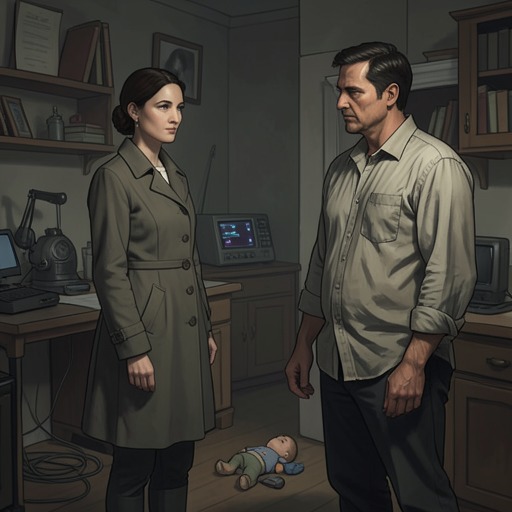
Rusty and Barbara’s marital crisis
Presumed InnocentRusty and Barbara’s marital crisis takes shape less as a single rupture than as a habit of living beside one another without understanding each other. Barbara’s private intellectual life, Rusty’s evasive attentiveness, and his affair with Carolyn Polhemus have all widened the distance between them. When Barbara learns of the affair, it gives their existing anger a name; when Carolyn dies, Rusty’s renewed fixation threatens the tentative hope that the marriage might recover.
A Household of Separate Lives
Rusty experiences home as a place where ordinary conversation and emotional distance coexist. Barbara delivers news about a neighbor’s illness, a mechanic’s bill, and her mother while lying face down on the bed, speaking with weary bitterness. Rusty answers with interest and enthusiasm, but describes this attentiveness as a defense: he acts as though he notices while an inward heaviness gathers. The routine shows how their domestic life can continue even as genuine exchange has thinned.
The gap between them also concerns Barbara’s ambitions and the limits of Rusty’s knowledge of her. About five years earlier, when he thought they might have another child, she told him she had applied to a mathematics Ph.D. program and taken its exams without telling him beforehand. He insists that he did not object to her pursuing study or to her not being homebound. What unsettled him was that he could not have anticipated the decision: Barbara had been exceptionally able at mathematics in college, yet had treated her talent casually and had not spoken of it as a calling. His surprise was understood by her as disapproval, and his later protests did not undo that interpretation.
Barbara’s dissertation becomes another persistent pressure in the household. She had once described projects like hers as potentially short, but the work lingers, contributing to her melancholy. Rusty sees her at her desk looking out toward a dwarf cherry tree that has failed to thrive in the clay landfill in their backyard. When she waits for inspiration, she reads extensively: university-library books on subjects including psycholinguistics, semiotics, Braille and sign language, life on Mars, and, more recently, cryogenics, artificial insemination, and the history of lenses. Rusty does not know what these studies mean to her. He recognizes that she might share what she learns if he asked, but says he has lost the ability to feign interest, while she regards his indifference as a failing.
His account of Barbara as socially abrupt, taciturn, and possessed of largely private interests is his own judgment, not a neutral portrait. He sees her with few serious friendships beyond her relationship with her mother, whom Barbara regards with suspicion, and describes her as keeping the house, caring for their child, and working at mathematical formulas and computer algorithms. The description captures both his sense of her isolation and the limits of his access to her inner life.
The Affair Becomes Speakable
Rusty does not tell Barbara about Carolyn while the affair is happening. He confesses only after it has ended and after he has resolved that it is past. During the month before the confession, he had been absent almost every evening, using preparation for a trial as an excuse; he later claimed that the trial had been continued. At an early dinner, after their son had gone to watch television, a drink and the sight of his highball tumbler—like one of Carolyn’s—bring the affair back with sudden force. Rusty breaks down in grief.
Barbara immediately understands that his crying concerns Carolyn, and reads it as loss rather than shame, fatigue, or trial stress. Her questioning is brief and unsparing: she asks who the woman was and whether Rusty is leaving. He says the relationship is over and minimizes its duration and importance. Barbara clears the dishes instead of comforting him. Later, while she exercises in the bedroom, Rusty is too distressed to make the ordinary appeal he had meant to make about continuing their marriage. Her anger and his silence leave the scene without reconciliation; she tells him he could have chosen better and insults the woman he has named.
A Fragile Explanation and Its Reversal
In retrospect, Rusty says that he and Barbara have carried on from that confrontation. Paradoxically, the affair has brought a kind of relief: it supplies a cause for the effect, an occasion for Barbara’s anger, and an explanation for why they do not get along. Because the breach is now something identifiable that they might get over, he can imagine a shadow of improvement. Their crisis is not resolved, but at least its pain has acquired a history and a possible object of repair.
That possibility depends on Rusty treating the affair as finished. Carolyn’s death undoes that condition. In Rusty’s account, Barbara had spent months treating Carolyn as a demon being exorcised from their home; the death brings her back into their marriage. Barbara understands that Rusty intends to revisit the relationship and the surrounding events, and accuses him of continuing to obsess over a woman who is dead. Rusty does not give up. He describes his reasons as intensely personal and unspoken, leaving Barbara to confront a renewed attachment she cannot accept and he cannot explain to her.
Conflict and Consequence
Barbara responds to this renewed fixation with anger rather than tears. She gathers books, the remote control, and pillows while sitting on the bed, then tells Rusty she will not endure his returning to the matter. He goes to the closet for his robe and leaves. When he later says he does not think he was important to Carolyn, Barbara calls him an asshole and orders him out. He leaves quickly, knowing she has been known to throw things, and crosses the hall to check on Nathaniel Sabich. Sitting beside his sleeping son in the dark, beneath the protective arms of a Spider-Man figure, Rusty finds a moment of company and safety outside the marital confrontation.
The crisis therefore turns on an asymmetry: Rusty experiences renewed attention to Carolyn as something he cannot relinquish, while Barbara experiences it as a threat to the limited progress they had made. The affair first gives their unhappiness a cause that might be overcome; the death transforms that cause into an unresolved presence. Their marriage continues through scenes of routine and shared household life, but the excerpt closes on separation within the home: Barbara sends Rusty away, and he seeks comfort beside their sleeping child.